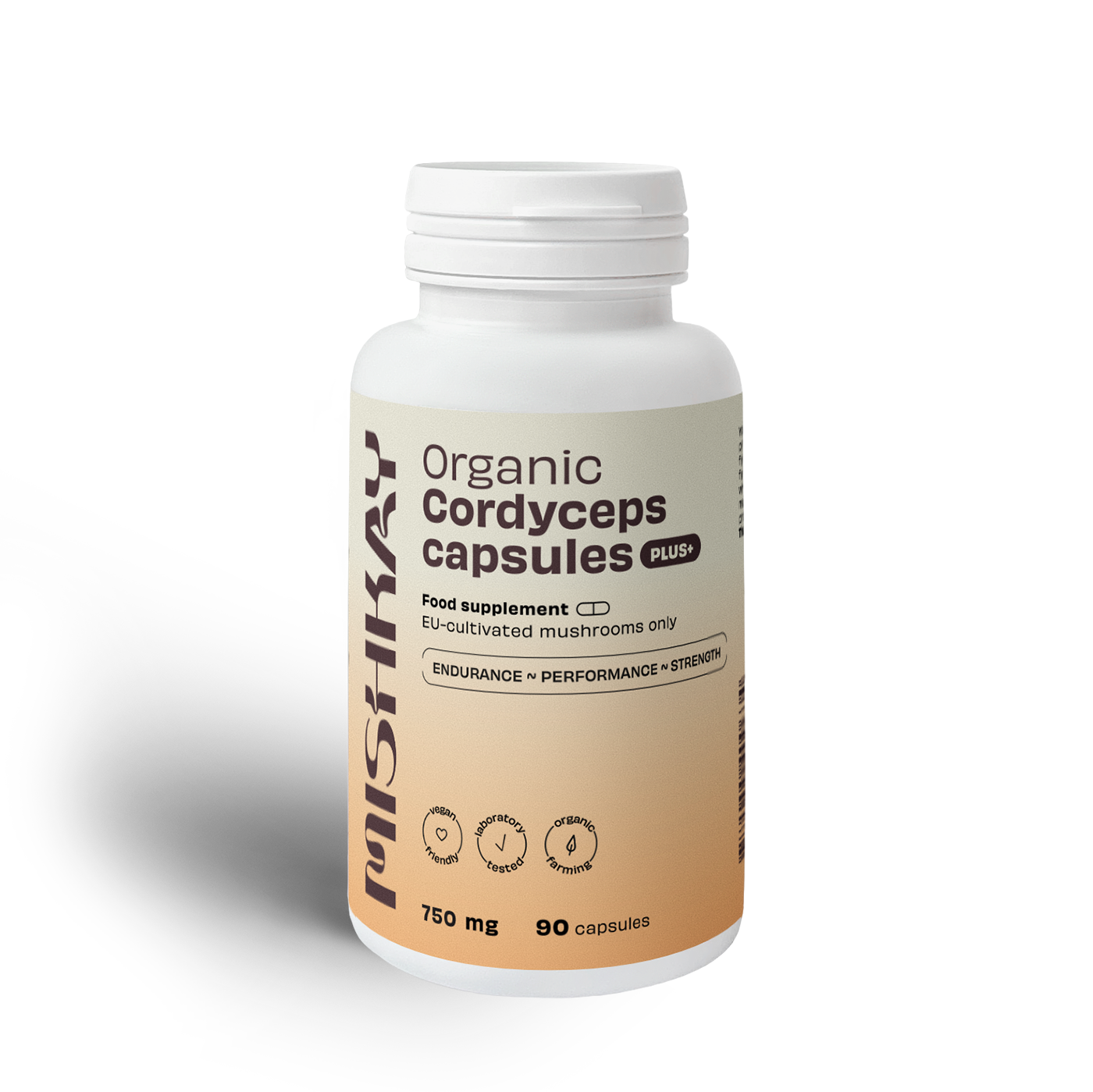
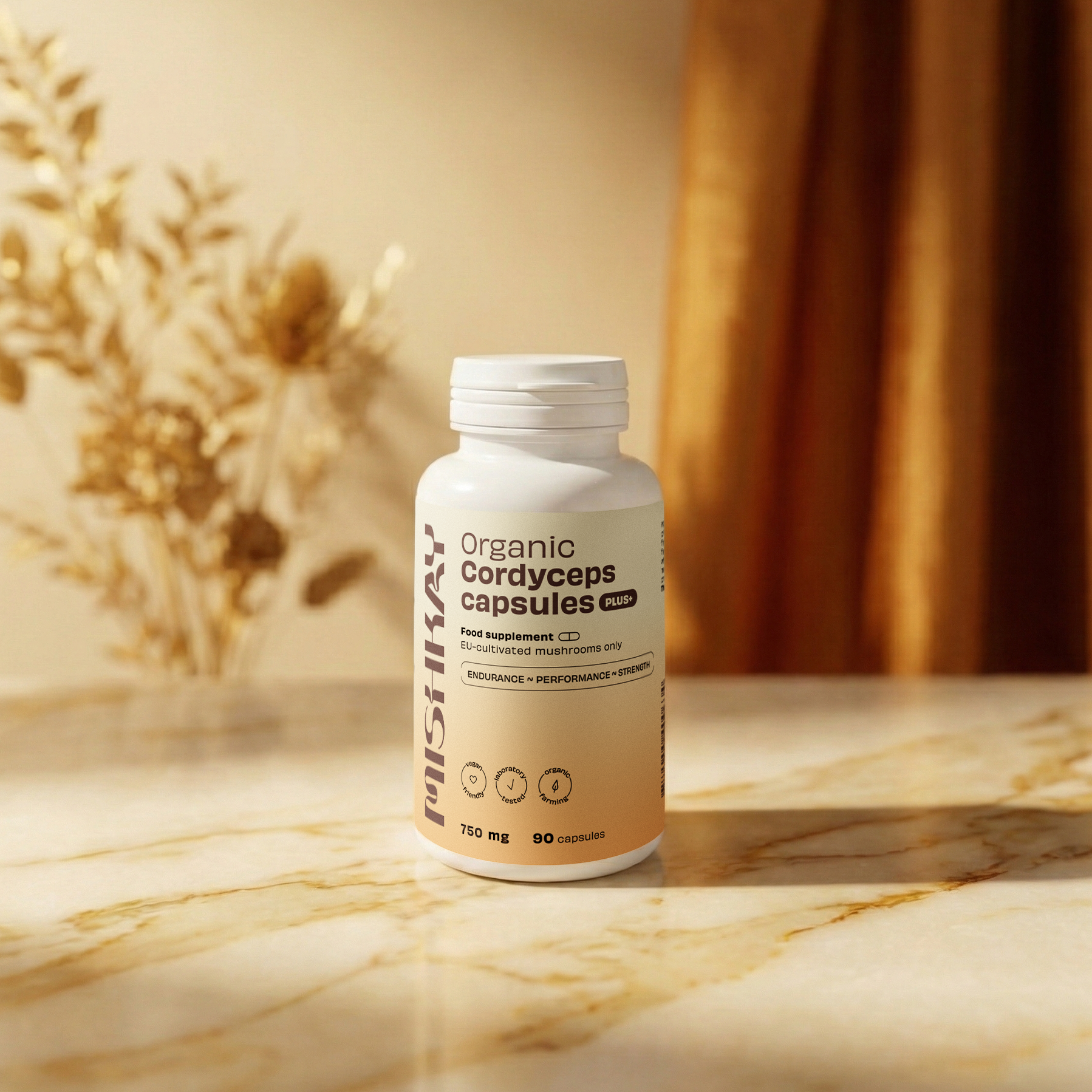


Organic Cordyceps Capsules PLUS+, 750 mg. (90 capsules)
45 day supply
 EndurancePerformanceStrength
Our NEW! stronger, standardized Cordyceps PLUS+ formula is here. More power 💪, more energy ⚡, more endurance 🏃!
Cordyceps sinensis is a fascinating species of parasitic fungi. Unlike most mushrooms that grow on trees, Cordyceps thrives on insect larvae, including moths, ants, and other insects like cicadas. When the spores land on a host, they develop into mycelium and begin to consume the insect from within. Once the insect is deceased, a fruiting body emerges from the mummified remains, rising above the ground to release its spores.
Historically, these mummified insects and the attached fungi were hand-collected and dried. Known as "Himalayan Gold," this remarkable mushroom has been a cornerstone of Traditional Chinese Medicine (TCM) for centuries.
Out of more than 500 discovered species, Cordyceps sinensis and Cordyceps militaris have garnered the most attention for their health benefits. Since 1964, Cordyceps sinensis has been officially listed as a herbal medicine in the Chinese Pharmacopoeia. In the wild, it is found at high altitudes of 3,500–5,000 meters, primarily in the Qinghai, Tibet, Sichuan, Yunnan, and Gansu provinces.
About Our Cordyceps Mushroom Capsules:
Our dried Cordyceps mushrooms are processed using an industrial superfine grinding method, reducing them to a near-dust consistency. This process breaks down chitin, releasing a broad spectrum of beneficial nutrients. Chitin is the primary building block of mushroom cell walls—the same durable material found in the exoskeletons of arthropods. Without disrupting the chitin molecules, these nutrients remain "locked" within the cells and pass through the digestive system unabsorbed.
The extract is prepared using spray drying, a technique that transforms liquid into dry powder by rapidly drying it with hot gas. This is arguably the most effective drying method for heat-sensitive substances like food and pharmaceuticals, or materials requiring an exceptionally uniform particle size.
Perfect for high-intensity athletes, physical workers, and those needing an energy and strength boost.

Key Benefits: Boosting energy and endurance for athletes, while supporting lung and heart health. It also promotes healthy liver function, joint mobility, potency, and a strong immune system.
Ingredients: Patented Organic Cordyceps (Cordyceps sinensis) Mushroom Blend (Mycelium and Mushroom Extract, dried on a gluten-free vegetable starch*), Hypromellose (vegan capsule shell).
*From certified organic farming
Polysaccharides: ≥30%

Certified according to: SI-EKO-003
Directions for use: Take 3 capsules daily in the morning or early afternoon, following a meal. Each capsule contains 750 mg of organic, standardized Cordyceps mushroom blend.
Warning: Do not exceed the recommended daily dose. The food supplement should not be used as a meal replacement. A varied and balanced diet and a healthy lifestyle are important. Not recommended for pregnant and breastfeeding women.
Best before: see on the packaging
Batch No.: see on the packaging
Storage conditions: store at room temperature, in a dry place, protected from direct sunlight and out of reach of children.
Net content: 67.5 g (90 capsules)
Seller UAB MISHKAY Biotech
Vilniaus g. 47, Molėtai
www.pjaunugryba.lt
Grown and produced in EU
Fun Fact: The Most Expensive Mushroom in the World
In the wild, Cordyceps grows in the remote reaches of the Tibetan Plateau and the Himalayan mountains. Some Himalayan villages are entirely dependent on the harvest and sale of this fungus, making it the primary livelihood for many families. It appears for only a few weeks each year in secluded regions of Nepal, Tibet, India, and Bhutan. However, finding it is incredibly difficult. Highly prized as a natural aphrodisiac, Cordyceps has been a cornerstone of Traditional Tibetan and Chinese Medicine for centuries.
Cordyceps sinensis, also known as Yartsa Gunbu in Tibetan (meaning "summer grass, winter worm"), holds the title of the world’s most expensive mushroom. In 2017, premium-quality specimens sold for as much as $140,000 per kilogram! On average, a single Cordyceps weighs approximately 300–500 mg.
The History of Cordyceps
Cordyceps sinensis is one of the most renowned remedies in Traditional Chinese Medicine, believed to have been discovered over 2,000 years ago. Its unusual appearance, resembling an orange caterpillar, was first noticed by Tibetan herders working at high altitudes. They used the fungus to combat the effects of low oxygen levels and to help their bodies endure the physical demands of the mountains.
The first official record of Cordyceps appeared in Wang Ang’s encyclopedia, Ben Cao Bei Yao, in 1694. Later, in 1878, the Italian scientist Saccardo formally named the species found in China Cordyceps sinensis.
Over time, the mushroom became a vital source of income for local farmers and herders. Today, more than 300,000 people in these regions depend on its harvest and sale. In primary production areas, Cordyceps sales account for 50–80% of the total annual income for roughly 80% of families.
Cordyceps gained global fame following the 1993 Chinese National Games, where a group of female athletes shattered nine world records. Their success was later attributed to their regular use of Cordyceps as part of their training regimen.
Since the 1970s, the price of Cordyceps in China has skyrocketed. This drastic increase is driven by surging global demand and a limited supply, as the fungus must still be meticulously hand-harvested in specific, high-altitude locations.
Ingedients
Dosage
Organic Cordyceps Capsules PLUS+, 750 mg. (90 capsules)
Sale price€29,80

Mushroom

How it will make my life better?
Important for you.
How does Cordyceps support athletic endurance?
Is Cordyceps helpful for post-workout recovery?
Can Cordyceps help with respiratory health?
What’s the recommended dose of Cordyceps for athletes?
Does Cordyceps have caffeine?